Showing posts with label Union Station. Show all posts

Northwestern Station

    I've never been much of a fan of the architect Helmut Jahn. I find that his work typically conveys bombast over quality and sensitivity. But his buildings are always interesting and often a notch or two above much of the work of his contemporaries.

    In the Eighties, Chicago's second grandest railway terminal, the Chicago and Northwestern Station, was razed to make way for this office building of Jahn's. The tower was christened Citycorp Center and the terminal portion has been recently renamed Ogilvie Transportation Center in honor of one of the very few Illinois governors who did not end up in jail after serving his term in office.

    Not bound by the purist (and false) Modernist dogma of pure functionalism, Jahn designed a building of arches and monumental spaces, all the hoopla that defined Art Deco revival. It casts a striking silhouette on the skyline.

    The old Northwestern Station designed by Frost and Granger and built in the Renaissance revival style in 1911 was magnificent. Like the original Union Station concourse, it made a great first impression on travelers who arrived from far and wide until the mid-sixties when its namesake railroad discontinued long distance passenger service. Unlike its larger counterpart down the street, all those entering Northwestern Station would pass through the grand waiting room under the building's most imposing feature, its beautiful Guastavino tile ceiling, common elsewhere but rare in Chicago.

    In its later days, as the clerestory windows of the waiting room had been tarred over, the waiting room was not bathed in natural light. But the lack of natural light was made up by the warm tones of the tiles and the massive green marble columns holding them up. By the time of its demise in 1984, the interior was filled with so many kiosks and illuminated signs, it was difficult to see its true beauty which was revealed one last time by the wrecking crew.

    The old station is truly missed by all who knew it. It was a great building that harkened back to the golden age of travel in America, and was a landmark that was well worth saving.

    Given that, its replacement is frankly not all that bad, especially if you compare it to the other commuter rail terminals in town, all built in the last forty years to replace much better, older stations. Faint praise indeed. Yet at OTC there is still the sense of having arrived after getting off your train from the suburbs and entering the impressive steel and glass interior. The building is at its best at rush hour when the throngs are hurrying to or from their trains. It is then that the beehive of activity that marks the urban experience is most evident.

    Unfortunately this place is all business. While there are lots of places to buy stuff or to eat and drink, save for an uninviting and embarrassingly small waiting room trackside, this is no place to sit down to watch all the activity.

    Efficient use of valuable property I suppose, the entire reason for the building's very existence and the glorious old one's demise.

Post Title

Northwestern Station


Post URL

https://guidice-galleries.blogspot.com/2010/04/northwestern-station.html


Visit guidice galleries for Daily Updated Wedding Dresses Collection

Union Station

    The tour of my list of unfortunate architectural contributions to our city continues with this uninspiring box that sits above the concourse of Union Station in the West Loop. The tower in the photograph on the right is Gateway Center III and the squat black building on the left is the MidAmerica Commodity Exchange. Both are the work of the inescapable firm of Skidmore Owings and Merrill.

    In a previous post I listed two criteria for truly awful buildings. This one meets both. Any building fronting the river sits on a prominent location and as such the architects have a responsibility to respond in kind with a building of at least some distinction. Can't see much in the cracker box tower. The Exchange Building at least has a trace of relevance, the estimable AIA Guide to Chicago describes it as "a supine version of the John Hancock Center."

    And any building that replaces a beloved building faces the inevitable comparison to its predecessor that is more often then not, negative, often to the extreme.

    I have a particular ax to grind with this one as I had a history with the original concourse building of the Union Station complex. When I was a small child, my grandparents would often take me Downtown on Sunday afternoons. One of our favorite haunts was Union Station which at the time consisted of two buildings. The headhouse still exists west of Canal Street. You can just barely see it in this photograph peeking over the addition on the left. The great waiting room was there as it still is, without a doubt one of the finest extant interiors in Chicago. East of Canal in a separate building was the concourse building.

    As great as the waiting room is, the interior of the concourse was arguably better. This was the first experience of Chicago that travelers from all over the country had as they disembarked from trains that had names like the Hiawatha, the Broadway Limited and the California Zephyr. And what an experience it was. The roof as you can see from this postcard rendering, was held up by arched trusses that were supported by iron posts, inspired by the concourse of the late, great Pennsylvania Station in New York. Chandeliers suspended in mid air illuminated the great space when golden beams of sunlight didn't stream through the windows. When you got off your train and walked into that space, you knew you had arrived at someplace special.

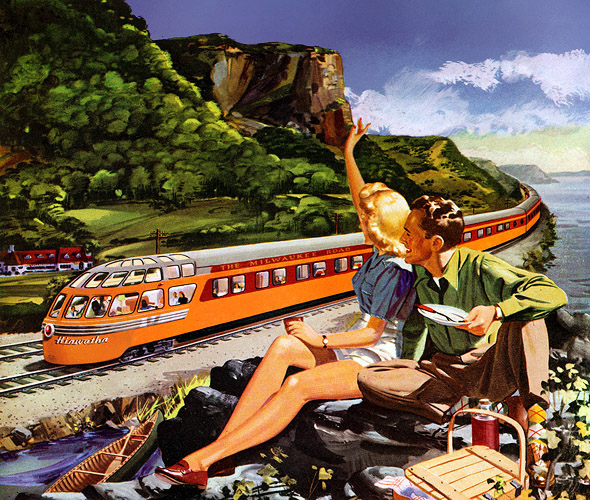
    This wasn't the only train station in Chicago by a long shot, but it was the grandest. It was the place where I fell in love with trains. While Union Staton was more often than not our Sunday destination, every once in a while we'd actually hop on a train, usually one of the commuter lines, the Burlington to Aurora, or the Milwaukee Road to Elgin. Then there was our annual summer trip to Milwaukee aboard the Hiawatha with its beautiful skytop lounge car designed by Brooks Stevens. Here it is from the inside.

    I remember coming back from those trips, getting off the train and the great concourse welcomed us back home like an old friend.

    The end came around the time the railroads gave up on passenger service and the national passenger service Amtrak was born. Everything became stripped down and the grand concourse was deemed superfluous as there was no revenue generating possibility in it as was the case with the offices across the street in the headhouse.

    I don't remember how I felt when I heard the news, as a child I was probably swayed by the propaganda of the time that you can't interfere with progress. There was an allure back then that I succumbed to of the new, the shiny, the modern, as opposed to the dingy, old buildings that symbolized the dark ages to many. I do remember my last few visits, disembarking from the Elgin train, seeing the place illuminated by the fading orange light at the end of the day and realizing that it soon would be no more. And I remember watching from the Adams Street bridge as the headache ball rammed into the clerestory window above the columns of the east side of the building as the grand old building stubbornly gave up her ghost.

    The construction of the new building lasted a year or two, and during that time you'd get off the train and be guided through construction tunnels that led either to the street above or to the waiting room which back then looked a little threadbare . Eventually the new building opened and it didn't appear much different than when it was under construction. Instead of great vaulted ceilings that reached forty feet up or more, you had dropped ceilings, 10 feet high if you were lucky, covered with acoustic tiles. The new joint was designed to be functional and efficient, but was neither, and the once grand arrival into Chicago was replaced by a whimper, or more tragically a whatever.

    The destruction of Union Station mirrors that of Penn Station in a few ways. The two buildings were state of the art train stations built toward the end of the golden age of rail travel. Both had similar architecture, Union Station being greatly influenced by the design of Penn's a decade earlier. And both were replaced by buildings that were so bad they had to be reworked several times during their existence. Penn Station's replacement itself has often been threatened with demolition. We're not so fortunate here.

    The interior of the Union Station concourse was remodeled in the nineties. While it doesn't come anywhere close to the magnificence of what was lost forty years ago it is much more palatable today than it was when it first opened.

    As for the exterior well...

Post Title

Union Station


Post URL

https://guidice-galleries.blogspot.com/2010/04/union-station.html


Visit guidice galleries for Daily Updated Wedding Dresses Collection

Popular Posts

My Blog List