Showing posts with label major tourist attraction. Show all posts

Avala Tower in Serbia

    The Avala Tower is a 204.5 m tall telecommunication tower located on Avala mountain near Belgrade, Serbia. It was destroyed in NATO attack of Serbia on 29 April 1999. On 21 December 2006 the renovation of Avala Tower started and tower was officially opened at a ceremony attended by highest state officials on 21 April 2010. It is at present tallest structure in Serbia and the Balkan region. The more details about Avala Tower is explained in world tour guides below.
    The tower was designed by architects Ugljesa Bogdanovic, Slobodan Janjic and engineer Milan Krstic. Construction started on 14 October 1961 and was completed four years later in 1965. The tower weighed 4,000 tonnes. Between 102 m and 135 m there was an enclosed observation deck. It was the only tower in the world to have an equilateral triangle as its cross section, and one of very few towers not perched directly into the ground, but standing on its legs. The legs formed a tripod making it one of the small number of towers to be constructed in that manner.

    The tower was surmounted by an antenna which was at first used for black and white television transmission. In 1971 the antenna was replaced by a new one for color TV transmission. The project which was of high risk was finished without any worker injuries or deaths which were unusual for a project of its size.

    Avala Tower was destroyed on 29 April 1999 by NATO attack allegedly to put Radio Television of Serbia off the air. Radio Television Serbia broadcasting did not suffer as it was relying on a network of local TV stations which were obliged to relay its program throughout whole of Serbia. The tower was one of last buildings to be destroyed before end of NATO operation. A special bomb was used to destroy the tower. The blast was one of loudest explosions heard throughout Belgrade during NATO attack. Between date of its destruction and 11 September 2001 it was tallest building ever destroyed succeeding the Singer Building. As of 2001 it is third tallest building ever destroyed.

    In 2004 Radio Television Serbia commenced a series of fund-raising events in order to collect money to construct the building once again at the same place it was destroyed. In 2005, clearing of the site where the tower was destroyed began and on 21 December 2006 the construction of a new Avala Tower commenced. An agreement regarding its construction was signed by Dusan Basara director of construction sector of Ratko Mitrovic Company which will be in charge of the construction of the tower and general director of RTS Aleksandar Tijanic.

    Initially completion of new tower was expected in August 2008, but construction works were severely delayed. The opening date was pushed back to 29 April, the tenth anniversary of its destruction. Radio Television Serbia reported on 23 October 2009 that the tower has been completed.

    Many fund raising events have been held for collection of funds so a new tower can be constructed. One of first was a match between Serbian grand slam winning tennis players Ana Ivanovic and Novak Dokovic. All the proceeds went to Avala Tower fund. Ceca Raznatovic a Serbian folk singer held a concert on 15 June 2006 with all the proceeds going to Avala Tower fund. Radio Television Serbia ran commercials for donations to rebuild the tower. According to a December 2006 report when it was announced that construction of a new Avala Tower would commence that same month over €1 million was collected through fund-raising and donations.

Post Title

Avala Tower in Serbia


Post URL

https://guidice-galleries.blogspot.com/2010/09/avala-tower-in-serbia.html


Visit guidice galleries for Daily Updated Wedding Dresses Collection

Carcassonne in France

    Carcassonne is a fortified French town in the Aude department which is the prefecture in the former province of Languedoc. It is separated into the fortified Cite de Carcassonne and the more expansive lower city, the ville basse. The folk etymology involving a chatelaine named Carcas a ruse ending a siege and the joyous ringing of bells though memorialized in a neo Gothic sculpture of Mme. Carcas on a column near the Narbonne Gate is of modern invention. The fortress, which was thoroughly restored in 1853 by the theorist and architect Eugene Viollet-le-Duc was added to the UNESCO list of World Heritage Sites in 1997.

    CarcassonneCarcassonne became strategically identified when Romans fortified hilltop around 100 BC and eventually made it colonia of Julia Carsaco later Carcasum. The main part of lower courses of northern ramparts dates from Gallo Roman times. In 462 Romans officially ceded Septimania to Visigothic king Theodoric II who had held Carcassonne since 453 he built more fortifications at Carcassonne which was a frontier post on northern marches traces of them still stand. Theodoric is thought to have begun predecessor of basilica that is now dedicated to Saint Nazaire. In 508 Visigoths successfully foiled attacks by the Frankish king Clovis. Saracens from Barcelona took Carcassonne in 725 but King Pepin Short drove them away in 759-60 though he took most of south of France he was unable to penetrate impregnable fortress of Carcassonne.

    The medieval fiefdom county of Carcassonne controlled city and its environs. It was often united with County of Razes. The origins of Carcassonne as a county probably lie in local representatives of Visigoths but first count known by name is Bello of time of Charlemagne. Bello founded a dynasty Bellonids which would rule many honores in Septimania and Catalonia for three centuries. In 1067 Carcassonne became property of Raimond Bernard Trencavel viscount of Albi and Nimes through his marriage with Ermengard, sister of last count of Carcassonne. In following centuries Trencavel family allied in succession either with counts of Barcelona or of Toulouse. They built Chateau Comtal and Basilica of Saint Nazaire. In 1096 Pope Urban II blessed foundation stones of new cathedral a Catholic bastion against Cathars.

    Carcassonne became famous in its role in Albigensian Crusades when city was a stronghold of Occitan Cathars. In August 1209 crusading army of Simon de Montfort forced its citizens to surrender. After capturing Raymond-Roger de Trencavel imprisoning him and allowing him to die Montfort made himself new viscount. He added to fortifications. Carcassonne became a border citadel between France and the kingdom of Aragon.

    Carcassonne was struck from roster of official fortifications under Napoleon and Restoration, and fortified cite of Carcassonne fell into such disrepair that French government decided that it should be demolished. A decree to that effect that was made official in 1849 caused an uproar. The antiquary and mayor of Carcassonne Jean Pierre Cros Mayrevieille and writer Prosper Merimee first inspector of ancient monuments led a campaign to preserve the fortress as a historical monument. Later in the year the architect Eugene Viollet-le-Duc already at work restoring the Basilica of Saint-Nazaire was commissioned to renovate the place.

    In 1853 works began with west and southwest walling followed by towers of Porte Narbonnaise and principal entrance to cite. The fortifications were consolidated here and there but chief attention was paid to restoring roofing of towers and ramparts where Viollet-le-Duc ordered the destruction of structures that had encroached against the walls, some of them of considerable age. Viollet-le-Duc left copious notes and drawings at his death in 1879 when his pupil Paul Boeswillwald and later architect Nodet continued rehabilitation of Carcassonne.

    CarcassonneCarcassonneThe restoration was strongly criticized during Viollet-le-Ducs lifetime. Fresh from work in north of France he made error of using slates and restoring roofs as pointed cones where local practice was traditionally of tile roofing and low slopes in a snow free environment. Viollet-le-Ducs achievement at Carcassonne is agreed to be a work of genius though not of strictest authenticity. Fortification consists of a double ring of ramparts and 53 towers. Another bridge Pont Marengo crosses Canal du Midi and provides access to railway station. Lac de la Cavayere has been created as a recreational lake and is about five minutes from the city centre.

    The newer part of city on other side of Aude River manufactures shoes, rubber and textiles. It is also center of a major AOC wine growing region. A major part of its income comes from tourism connected to fortifications and from boat cruising on Canal du Midi. Carcassonne receives about 3 million visitors annually. In late 1990s Carcassonne airport started taking budget flights to and from European airports and by 2009 had regular flight connections with Bournemouth, Cork, Dublin, Edinburgh, Frankfurt-Hahn, Stansted, Liverpool, East Midlands and Charleroi.

Post Title

Carcassonne in France


Post URL

https://guidice-galleries.blogspot.com/2010/09/carcassonne-in-france.html


Visit guidice galleries for Daily Updated Wedding Dresses Collection

Zugspitze Mountain in Germany

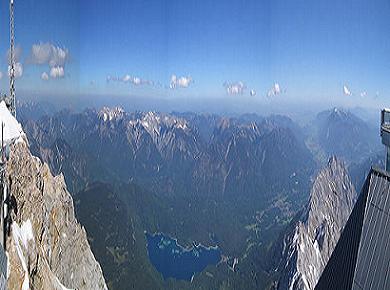
    The Zugspitze is highest mountain in Germany at 2,962 metres above sea level. It is located on Austrian border beside the town of Grainau in district of Garmisch Partenkirchen in federal-state of Bavaria. On Austrian side lies the town of Ehrwald in district of Reutte, Tyrol. There is a cog railway leading from tourist resort of Garmisch-Partenkirchen to Zugspitzplatt from where a cable car runs to peak. There are also two cable cars that go to peak from the base of mountain one ascends from German side of mountain at lake Eibsee and other ascends from Austria near Ehrwald. The peak is regularly crowded with tourists. The details of Zugspitze are explained in world tour guides below.

    Zugspitze MountainFor those wishing to reach the summit under their own power, various hiking and ski trails can also be followed to the top. Hiking to the top from the base takes between one and two days, or a few hours for the very fit. Food and lodging is available on some trails. In winter the Zugspitze is a popular skiing and snowboarding destination, with several slopes on both sides. The Zugspitzplatt is Germany's highest ski resort, and thus normally has sufficient snow throughout the winter.
    The border between Germany and Austria goes right through the mountain. There used to be a border checkpoint at the summit. But since Germany and Austria are now both part of the Schengen zone, the border crossing is no longer staffed. The Zugspitze belongs to the Wetterstein range in the Northern Limestone Alps. It gets its name from the many avalanche passages on its steep north slopes. At the Zugspitzes summit is the Munchner Haus a mountain hut, a facility built by the German Alpine Club. For more than a hundred years, the summit has also had a weather station, which nowadays also gathers data for the Global Atmosphere Watch.

    Shortly after World War II the US military took over the Schneefernerhaus for the exclusive use of US military and civilian employees. Room rates, including meals, were US $ 1 per day. Ski lessons were available, taught by Austrians and Germans, at a cost of US $ 0.25 per hour. The first recorded ascent to the summit was accomplished by a team of land surveyors on the 27th of August, 1820. The team was led by Lieutenant Josef Naus who was accompanied by two men named Maier and G.Deutschl. However, local people had conquered the peak over 50 years earlier, according to a 1770 map discovered by the Alpenverein.

    On 7 January 1882 the first successful winter assault on Zugspitze was accomplished by F. Kilger, H. and J. Zametzer and H. Schwaiger. Climbing up Zugspitze can involve several routes. The large difference in elevation between Garmisch-Partenkirchen and summit is 2 200 m making the climb a challenge even for trained mountaineers. On German side from Garmisch-Partenkirchen climbers go either through Hollental or Reintal. The way through Reintal is easiest but also longest and takes 8 to 10 hours. This path goes through the Partnachklamm a scenic gorge then through Reintal up to Zugspitzplatt, a barren plateau from there up to the summit. Climbers can stay for night at two alpine huts Reintalangerhutte or Knorrhutte.

    Zugspitze MountainZugspitze Mountain
    The more popular but harder route is through Hollental. It starts at Hammersbach near Garmisch goes through Hollentalklamm a similar gorge up to Hollentalangerhutte where one can take a meal or stay for night. It then crosses Hollentalferner remnants of a small glacier. After that it traverses a wall with help of iron ladders and steps. Via ferrata equipment is recommended for that part. Over Irmerscharte it reaches the summit. This path will take 7 to 8 hours.

    From Austrian village of Ehrwald there are also two variants. One goes straight through the Western Flank, which is the shortest route overall, but rather hard. It includes via ferrata and there is a hut called Wiener Neustadter Hutte by Austrian Alpine Club. An easier path leads via Ehrwalder Alm across a small pass called Gatterl joining Reintal path at Knorrhutte. The Zugspitzes exact height was a matter of debate for quite a while. Given figures ranged from 2 960 m to 2 970 m but it is now generally accepted that peak is 2962 m above sea level as a result of a survey carried out by the Bavarian land survey office. The lounge at new cafe is named 2962 for this reason.

Post Title

Zugspitze Mountain in Germany


Post URL

https://guidice-galleries.blogspot.com/2010/08/zugspitze-mountain-in-germany.html


Visit guidice galleries for Daily Updated Wedding Dresses Collection

Megyeri Bridge

    The Megyeri Bridge previously known as Northern M0 Danube Bridge is a cable stayed bridge that spans River Danube between Buda and Pest respectively west and east sides of Budapest, capital of Hungary. It is an important section of M0 ringroad around Budapest. The details of Megyeri Bridge are explained in world tour guides below.

    Megyeri BridgeThe bridge cost 63 billion forints approximately US$ 300M to build and was officially opened on September 30, 2008 however National Transport Authority of Hungary has only issued temporary permits because of disagreement among suburban cities surrounding the bridge. A naming poll to determine new name of recently-built bridge caused controversy and received media attention when American comedians Stephen Colbert and Jon Stewart won. The total length of bridge is 1862m. Structurally it is composed of five parts. They are Left quayside inundation area bridge 148m, Main Danube-branch bridge cable stayed 590m with a span of 300m, Szentendre island inundation area bridge 559m, Szentendre Danube-branch bridge 332m and Right quayside inundation area bridge 218m.

    The Ministry of Economic Affairs and Transport of Hungary organized a public vote online to solicit possible names for new bridge. The three names with most votes as well as suggestions from local governments, cartographers, linguists and other experts were to be reviewed by government committee before a final name for bridge was chosen. New nominations were accepted until August 21, 2006, and voting ended on September 8, 2006, with Stephen Colbert winning with 93,163 votes, and Jon Stewart and Zrinyi close behind with 85,171 and 83,966 votes, respectively.

    On August 1, 2006 Reuters reported that top candidate according to the online poll was the Chuck Norris hid named for American action star Chuck Norris. On August 11, 2006 American satirist Stephen Colbert discussed story on his comedy program The Colbert Report instructing his viewers to visit polling website and vote for him instead of Norris. The next day the number of votes for him had grown 230 times and he now asked his viewers to follow a link from his own Colbert Nation website to avoid all that illegible Hungarian. Colberts site also indirectly offered techniques for stuffing the ballot box as users of their forums created several automated scripts to cast multiple votes for Colbert.

    Megyeri BridgeMegyeri Bridge
    On August 15, 2006 he repeated his call to be voted top of Hungarian poll and by August 22, 2006 Stephen Colbert hid was in first with 17 million votes about 14 million votes ahead of second-placed Zrinyi hid named after Croatian Hungarian national hero Miklos Zrinyi and about 7 million more than entire population of Hungary. The same day site announced a new round of voting which would require registration to participate and Colbert asked his viewers to call off dogs requesting on his website that fans stop using scripts to vote. Despite this Stephen Colbert hid remained in the top position on the website in the second round.

    On September 14, 2006 Andras Simonyi the ambassador of Hungary to the United States announced on The Colbert Report that Stephen Colbert had won the vote. Unfortunately for Colbert Ambassador Simonyi declared that under Hungarian law Colbert would have to be fluent in Hungarian and would have to be deceased in order to have the bridge named for him. However after saying the rules could most likely be bent he invited Colbert to visit Hungary and view the construction in person and gave him a Hungarian passport and a 10,000 HUF Bill with an approximate value of as the ambassador put it fifty dollars, fifty good US dollars. Colbert promptly tried to bribe him with said money.

Post Title

Megyeri Bridge


Post URL

https://guidice-galleries.blogspot.com/2010/08/megyeri-bridge.html


Visit guidice galleries for Daily Updated Wedding Dresses Collection

Kochi Castle in Japan

    Kochi Castle is a castle located in Kochi, Kochi Prefecture, Japan. Next to the Battle of Sekigahara in 1600 Kochi Castle was constructed in what was then the province of Tosa. It was built by Yamanouchi Kazutoyo who took control of the province after the Tokugawa victory. The castle was constructed as part of the move from Urado to the more defensible Otakasa area. The details of Kochi Castle are explained in world tour guides below.

    Kochi CastleThe construction of Kochi Castle was begun in 1601 and was completed in 1611. Much of original fortress burned down in 1727. It was reconstructed between 1729 and 1753 in original style. The castle underwent major restoration from 1948 to 1959. Though no battles were fought at castle it is remarkable because castle is the original structure and not a post war replica. It is also the only castle in Japan to retain both its original tenshu or keep and its palace. In fact, it is the only castle to have all the original buildings in the honmaru or innermost ring of defense, still standing.

    Two previous attempts were made to build castles on Otakasa Hill. Both failed. The first attempt was by Otakasa Matsuomaru sometime during the late Heian or Kamakura periods. The second was in 1588 by the conqueror of Shikoku Chosokabe Motochika. The area around the hill at this time was extremely swampy due to the influx of alluvial sediments from the Kagami River. Consequently, previous builders were never successful in establishing a permanent fortress on the site where Kochi Castle stands today.

    As one of only twelve intact castles in Japan, Kochi Castle was popularly called a National Treasure before the 1950 National Treasure Protection Law was enacted. After the law was passed, it was demoted to the status of Important Cultural Asset. Kochi Castle can be seen in the background of the animated film I Can Hear the Sea by Studio Ghibli during the class reunion scene. The castle figures prominently in the film The Harimaya Bridge. Key scenes in the movie take place in the courtyard just inside the Oteman Gate on the top level of the castle itself, and at the entrance to the castle grounds just outside the Oteman Gate.

    Two rivers, the Kagami River and the Enokuchi River, form the outer moat of the castle. The tower is five stories high and sits atop Otakasa Hill, commanding an extensive view of the city. It rises above the Kaitokukan palace which was constructed in the Shoin style of the Edo period. The castle retains this structure today and has been fitted with period-appropriate items in the lower rooms. In addition to a tearoom, Genkan entrance area and latrine the Kaitokukan contains eight traditional rooms, ranging in size from three to twelve tatami. It is surrounded by a veranda on the east and south sides. The Kaitokukan also burned during the fire of 1727, but it was not repaired until 1747, with work completed in 1749.

    Kochi CastleKochi CastleKochi Castle is located in downtown Kochi. The main entrance is directly across from the west entrance of the Obiyamachi shopping area. Visitors are asked to remove their footwear before entering the building. Slippers are provided. As the castle is quite old, the tatami rooms are visible but not accessible. There is a small museum area with information entirely in Japanese. This museum houses several cultural artifacts of the Tosa region not native to the castle itself.

    The upper rooms of the tower are all empty, but visitors are allowed to climb to the top. There is a railing but no net around the balcony. Handicap access is extremely limited as the approach to the castle involves many steps. There is no elevator. The castle grounds are now a public park, and a popular location in spring for hanami. They contain the Prefectural Library and the Kochi Literary Museum, in addition to statues of notable scions of the Yamanouchi family.

Post Title

Kochi Castle in Japan


Post URL

https://guidice-galleries.blogspot.com/2010/08/kochi-castle-in-japan.html


Visit guidice galleries for Daily Updated Wedding Dresses Collection
Roskilde Cathedral

    Roskilde Cathedral is a cathedral in the city of Roskilde on Island of Zealand in eastern Denmark. It was the first Gothic cathedral to be built of brick and its construction encouraged the spread of this Brick Gothic style throughout Northern Europe which was built during 12th and 13th centuries and incorporates both Gothic and Romanesque architectural features in its design. It was the only cathedral in Zealand until the 20th century. The details of Roskilde Cathedral are explained in world tour guides below.

    Roskilde CathedralRoskilde Cathedral has been the main burial site for Danish monarchs since the 15th century. As such, it has been significantly extended and altered over time as individual rulers have added multiple burial chapels. Following the Reformation in 1536 the Bishops residence was moved to Copenhagen, and he from then on held the title Bishop of Zealand. Royal coronations normally took place in Copenhagens Church of Our Lady or the chapel of Frederiksborg Palace. It is a major tourist attraction bringing in over 125,000 visitors annually. Since 1995 the cathedral has been listed as a UNESCO World Heritage Site.

    The cathedral has been the home of one of Denmark leading boys choirs, the Roskilde Cathedral Boys Choir. The choir soon celebrating its 20th birthday is a key resource in the parish youth work. All choristers go to normal school but meet up 2-3 times a week to rehearse. Every second year the choir travels abroad destinations being as different as New Zealand, Scandinavia, England, Greenland, France and Canada. Roskilde was named as the new capital of Denmark by King Harald Bluetooth about the year 960. A small timber church was built there and dedicated to the Holy Trinity. King Harald was buried inside the little church at Roskilde but no trace of it has ever been located.

    In about 991 Roskilde was made seat of Bishop of Roskilde under supervision of Archbishop of Hamburg, who had responsibility for converting pagan kingdoms of Scandinavia. The bishop was responsible for island of Zealand, Scania, and islands to south including Rugen off coast of northern Germany. The church was built in Romanesque style with half rounded interior arches to support the flat interior ceiling. A three sided stone monastery was constructed adjoining cathedral on north side for monks and others associated with cathedral. Bishop Svend succeeded in bringing an important relic, skull of St. Lucius, an early pope, who became patron saint of the cathedral. The skull is now located in Catholic Cathedral of St. Ansgar in Copenhagen.

    Bishop Jacob Erlandsen built a school at cathedral for education of poor children in 1249. In 1310 a Lady Chapel was added onto cathedral of present mausoleum which houses tombs of many of Denmarks recent royal family. Bishop Peder Jensen Lodehat forcibly removed body of Queen Margrethe I from Soro Abbey in 1414 and interred her with great pomp inside cathedral. In 1439 work began on interior of cathedral, proceeding as far as the choir. But on 14 May 1443 a terrible fire swept through city and burned cathedral. It was damaged so severely that it was not rededicated until 1464, built in footprint of earlier building. King Christian I paid for addition of a new Chapel of Three Kings as part of overall reconstruction.

    Roskilde CathedralRoskilde Margrethe GraveThe cathedral was last bastion of Catholicism in Sjaelland but in 1536 Lutheran Superintendent of Zealand moved to Copenhagen, although Roskilde was still officially cathedral. The decline of Roskilde was precipitous, all the monasteries, church schools, chapter houses, were closed and property snapped up by crown or local noble families. The cathedrals gigantic crucifix and other Catholic symbols were taken down or destroyed. Because the church was a royal resting place, the cathedral was spared the savage looting of churches that accompanied the Reformation in other parts of the country. Superintendents quickly were titled bishops again and Bishop of Zealand continued to live and work from Copenhagen until Zealand Diocese was split from Copenhagen in 1920s.

    In 1635-6 two west towers were raised and given now familiar tall thin spires clad in copper. The towers house six bells. The oldest surviving bell was cast in 1508 by Hans Jensen. Johannes Fastenowe cast two bells in 1511 paid for by Bishop Johan Ravensberg. The largest bell Stormklokken hangs in the north tower. Burchado cast a bell in 1594 that hangs with the Jensen and smaller Fastenowe bell in the south tower. A magnificent Royal Door on the west front was carved by Geert Barchmann. The new portal was used only on state occasions visitors enter by the south door. The beautiful entrance was later moved to Holmen Church in Copenhagen. In 1645 Zealand's bishop ordered the recording of all baptism, marriages, and deaths throughout Zealand and many of Denmark's earliest vital records exist as a result.

Post Title

Roskilde Cathedral


Post URL

https://guidice-galleries.blogspot.com/2010/08/roskilde-cathedral.html


Visit guidice galleries for Daily Updated Wedding Dresses Collection

Lake Titicaca

    Lake Titicaca is a lake located on the border of Peru and Bolivia. It sits 3,811 m above sea level making it the highest commercially navigable lake in the world. By volume of water it is also the largest lake in South America. The details of Lake Titicaca are explained in world tour guides below.

    Lake TiticacaThe lake is located at the northern end of the endorheic Altiplano basin high in the Andes on the border of Peru and Bolivia. The western part of the lake lies within the Puno Region of Peru, and the eastern side is located in the Bolivian La Paz Department. The lake is composed of two nearly separate sub-basins that are connected by the Strait of Tiquina which is 800 m across at the narrowest point. The larger sub basin Lago Grande has a mean depth of 135 m and a maximum depth of 284 m. The smaller sub basin Winaymarka has a mean depth of 9 m and a maximum depth of 40 m. The overall average depth of the lake is 107 m.

    Lake Titicaca is fed by rainfall and meltwater from glaciers on the sierras that abut the Altiplano. Five major river systems feed into Lake Titicaca. In order of their relative flow volumes these are Ramis, Coata, Ilave, Huancane and Suchez. More than 20 other smaller streams empty into Titicaca, and the lake has 41 islands, some of which are densely populated. The cold sources and winds over the lake give it an average surface temperature of 10 to 14 °C. In the winter mixing occurs with the deeper waters, which are always between 10 to 11 °C.

    The origin of name Titicaca is unknown. It has been translated as Rock Puma for its resembling shape of a puma hunting a rabbit, combining words from the local languages Quechua and Aymara and as well as translated as Crag of Lead. The southeast quarter of lake is separate from main body the Bolivians calling it Lago Huinaymarca and larger part Lago Chucuito. In Peru these smaller and larger parts are referred to as Lago Pequeno and Lago Grande respectively. Titicaca is notable for a population of people who live on the Uros a group of 42 or so artificial islands made of floating reeds. These islands have become a major tourist attraction for Peru drawing excursions from lakeside city of Puno.

    Amantani is another small island on Lake Titicaca populated by Quechua speakers. About 800 families live in six villages on the roughly circular 15 square kilometres island. There are two mountain peaks called Pachatata and Pachamama, and ancient ruins on the top of both peaks. The hillsides that rise up from the lake are terraced and planted with wheat, potatoes, and vegetables. Most of the small fields are worked by hand. Long stone fences divide the fields, and cattle, sheep, and alpacas graze on the hillsides.

    AmantaniTaquile IslandTaquile is a hilly island located 35 kilometres east of Puno. It is narrow and long and was used as a prison during the Spanish Colony and into the 20th century. In 1970 it became property of the Taquile people, who have inhabited the island. Pre Inca ruins are found on the highest part of the island, and agricultural terraces on hillsides. Situated on the Bolivian side of lake with regular boat links to Bolivian town of Copacabana, Isla del Sol is one of the lakes largest islands. Geographically, the terrain is harsh; it is a rocky, hilly island. There are no motor vehicles or paved roads on the island. The main economic activity of the approximately 800 families on the island is farming, with fishing and tourism augmenting the subsistence economy.

    Isla de la Luna is situated east from the bigger Isla del Sol. According to legends that refer to Inca mythology Isla de la Luna is where Viracocha commanded the rising of the moon. Ruins of a supposed Inca nunnery occupy the oriental shore. Suriqui lies in the Bolivian part of Lake Titicaca. Suriqui is thought to be the last place where the art of reed boat construction survives, at least as late as 1998. Craftsmen from Suriqui helped Thor Heyerdahl in the construction of several of his projects, such as the reed boats Ra II and Tigris, and a balloon gondola.

Post Title

Lake Titicaca


Post URL

https://guidice-galleries.blogspot.com/2010/08/lake-titicaca.html


Visit guidice galleries for Daily Updated Wedding Dresses Collection

Popular Posts

My Blog List